Monday, April 16, 2012

Statues and Ornaments

 On our first morning walk in Hanoi, around the small lake near our hotel, we saw these topiary animals.
 On the other side of the lake we saw these two dragons carved out of shrubbery, next to a globe with Vietnam firmly marked in the center.  And we though we lived in the center of the world!

 The Vietnamese take delight in natural forms as much as in sculpture.  You can plant a mountain in your garden.

 We could never figure out whether statues like these were of what they call "unicorns" (not the Western unicorn with a long horn coming out of its forehead) or another type of protective being.
 This little dog, presiding over an altar, is on the Japanese bridge in Hoi An.
 Here's the dog's companion.  These are, of course, votive statures, but they're also decorative, and it's hard for the tourist to know how seriously people take these symbolic statues.
 This bronze basin is in a courtyard in the Emperor's citadel in Hue.  The monumental bronze work there is impressive both aesthetically and technically.
 The tourist boats in Hue all have these striking statues on their prows.  Of course we took a boat ride.  In fact, we took more boat rides in our two weeks in Vietnam than we took in the previous two years or more.

 These statues, almost life size, stand in a courtyard at the tomb of the second to last emperor of Vietnam, in Hue.
 On our way to the Mekong Delata from Saigon, our guide took us to a temple with two enormous votive statues.
To our eyes, this enormous statue is absolutely grotesque, but I assume that Vietnamese eyes see it differently - though I'm sure that people of good taste must be offended by the enormous amount of money that was invested in this idol.  I can't imagine that the Buddha would be pleased be it.

Sunday, April 15, 2012

Food on Display

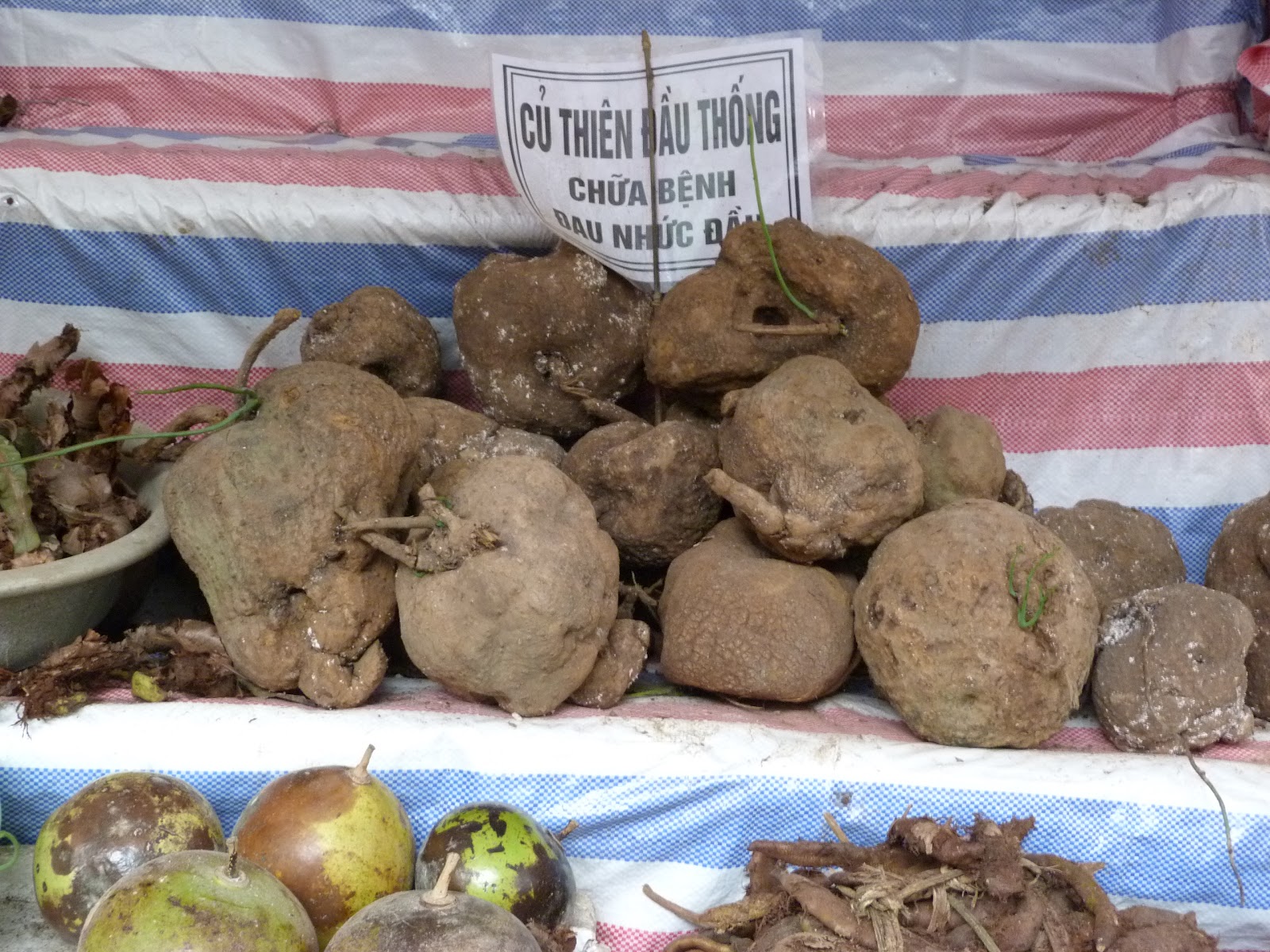
 These roots and the green fruit were meant to be left as offerings at the Perfume Pagoda.

 This meat was on display at the restaurant where we ate at the Perfume Pagoda, a huge establishment with long tables in a kind of tent.

 These are a very common Vietnamese street food called ban chung.  You can find a recipe for them here: http://www.epicurious.com/recipes/food/views/Vietnamese-Rice-Cakes-in-Banana-Leaves-233845

 We didn't weren't always attracted by the way the food was displayed in the market.
Our guide called these "rice paper."  You can buy them wrapped in cellophane.
 This is how a very delicious fish arrived at our table in a very simple restaurant on a farm in the Mekong Delta.
Turning food into sculpture is a favorite Vietnamese trick.

Thursday, April 12, 2012

Floating Market in the Mekong Delta

A mode of commerce that is apparently being replaced, as roads are improved and entrepreneurs acquire trucks: boat owners buy food from farmers upriver, bring it down to the floating market, and sell it to local merchants.


To Market in Vietnam


Pictures that need no explanation. 
It's just important to remember how much work, care, and tradition go into these abundant displays of food - growing it, bringing it to the market, arranging it attractively, staying at the ready to sell it from early morning until late afternoon, and putting everything away when the day is over.

Wednesday, April 11, 2012

Things to Eat (or not) in Vietnam - Part One

As the time passes, and my life fills up with other activities, the trip to Vietnam recedes in my consciousness.  I am trying to keep the memory fresh by going through my pictures.
The food in Vietnam seemed abundant in the markets, in sidewalk restaurants selling whole meals, and in restaurants.  Because of our Jewish dietary restrictions (about which we were much more flexible than truly orthodox Jews), we couldn't eat a lot of the food that we saw.  Here's a small sampling.
The first three pictures were taken on our visit to the Perfume Pagoda near Hanoi, not so much a tourist destination as a pilgrimage site for masses of Vietnamese.
They may be Buddhist, but they are not vegetarians.


 The next two pictures were taken in one of the many markets we visited.  We loved the sights, smells, and activity of the markets, but we also remembered that for the people selling, mainly women, the markets are a tiring and chancy way of making a bit of money.
The last picture was taken at a kind of family candy factory on an island in the Mekong Delat.  We aren't sure what the people were planning to do with the snakes in the huge jar.  Possibly they were planning to put them in bottles of the local rice brandy, their way of adding potency to the brew - though most of the little bottles with snakes and scorpions in them, along with the liquor, were clearly meant to be taken home by tourists as souvenirs.

Wednesday, April 4, 2012

Ha Long Bay

Everywhere we went in Vietnam, we were conspicuously tourists. If you look European, you can't hide the difference between you and the Vietnamese.  In a way, that was liberating.  If you're a tourist, go for it!
One of the super-touristic things we did was spend a night on a Chinese style junk in Ha Long Bay, one of the most beautiful places in the world.  There were about twenty other passengers, from France, England, and Australia, and we were pampered, fed exquisitely, and given plenty of time to relax.
We had a guide, who called himself "Popeye" because his Vietnamese name was too hard for Westerners to pronounce, even though it was only one syllable.
We stopped on one of the many islands that jut out of the sea, which has been leased to the company that ran our boats.
I was hoping to go swimming, but the water was too cold.
We did take a little trip in kayaks, something I'd never done before.
We stopped in the floating fishing village, where we could have bought some pearls in the store.  We settled for some tee-shirts for the grandchildren.
Popeye explained to us that the fishermen used to live in a cave on the island that we visited, but they were persuaded they would be better off in the floating village that was built for them, where they could have television and schools for their children.
As usual, it was hard to evaluate the information we were receiving.  Obviously Popeye wasn't going to tell us that the evil company he worked for had forced the poor fishermen to accept an offer they couldn't refuse.
Did the fishermen really benefit from being placed in their floating quarters?  Did they have any choice?  Do they have any chance for upward mobility?
Their life, like the lives of so many of the peope we saw, is barely above subsistence level.  None of them is going to get rich by catching fish in Ha Long Bay.  So will their children also end up living in one room floating houses and eking out a hard living from the water?

Tuesday, April 3, 2012

Fishermen

These are the Vietnamese water puppets, a pair of fishermen in a boat.  We saw a lot of people fishing for a living or to supplement their living.
Not only is Vietnam blessed with an abundance of water (and sometimes cursed with flooding), but the water is rich in nutritious animals, even in places that are full of action, like pilgrimage sites, where thousands of visitors come every day.
Mainly people row small boats and fish with modest, traditional equipment.  Without outboard motors, there's less pollution.  Anyway, they don't have to go very far to find fish.


The man wading with a net is retrieving fresh water clams from the river.
The other pictures more or less speak for themselves.  They were taken from boats, because almost every day trip we took involved an excursion in an aluminum, flat-botton, stub-nosed rowboat, usually rowed by a young woman.


 This is a floating fishermen's village in Ha Long Bay, one of those places that's so scenic that you get tired of the beauty.
On one of our water excursions, in Hoi An, we came upon a fisherman casting his net out into the river.  After I took a couple of pictures, he rowed over to our boat and asked for a tip.  He earned it.