Sunday, April 22, 2012

What am I doing?

 On our last evening in Hanoi we took a walk, and Judith was attracted to the display window of an antique shop.  It was already dark, but the shop was still open, and we started looking around, without intending to buy anything.  In the end we did buy some stone figurines, which I'm saving for another entry.
The store was in a typical urban house, quite narrow and about five stories tall.  To pay with my credit card, I had to go up to the third floor with the owner, a vigorous man of about my age, whose English was limited, but whose enthusiasm for his wares was extreme.  He knew I wasn't going to buy anything more expensive than the figurines, but he kept showing my treasure after treasure, including this jade sculpture of horses drawing a royal chariot, which you can buy for only $25,000.
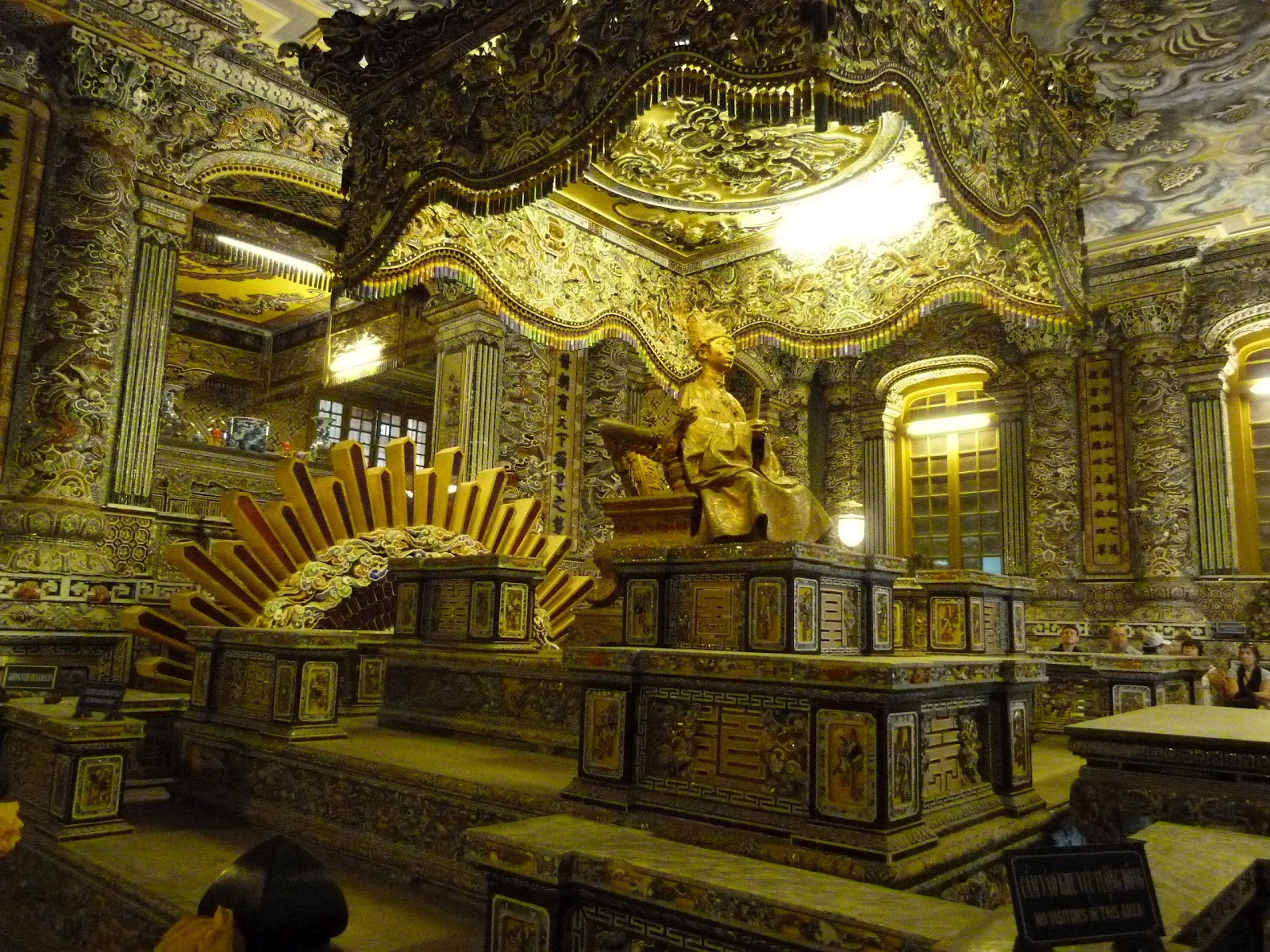
Another example of Vietnamese splendor is one of the emperor's tombs in Hue, one of the places you more or less have to go as a tourist in Vietnam.
Meanwhile, while looking for some information about Vietnam, I came upon the website of a very accomplished photographer and dedicated traveler named Matthew Herschmann.
I haven't had time to look at all of his hundreds of pictures of many places in Asia. He is essentially a professional travel photographer, and I am resolutely an amateur.  I took the pictures in Vietnam to remember our trip, and I'm sharing them with modest expectations.  Our trip to Vietnam was surprisingly significant to me personally, opening me up to an unfamiliar culture and thus giving me insight into the monotheistic, Mediterranean culture I live in.  We barely spent two weeks in Asia, certainly not enough time to understand anything about it, but enough time to be stimulated and puzzled.
That's the kind of traveler I am.

Chinese Temple in Saigon

 We rebelled in Ho Chi Minh City and refused to go to the network of caves and tunnels where the Viet Cong held out against the forces of the south and the US, sparing ourselves a long drive and crawling through tunnels.  This was the advantage of being on a private tour, withour own guide and driver.
Our guide then offered to take us to the Chinese quarter of Saigon, and there she took us to a fascinating temple with wonderful decorations, theThien Hau Temple.
Most of them are, as in the picture to the left, high up on the cornices of the building.
 Fortunately my camera has a powerful telescopic lens, so I was able to record some of the reliefs for later viewing.
This, I believe, is a portrayal of a goddess who rescues seamen.
 The temple is full of busy, crowded reliefs, which are hard to decipher from down on the floor.
I don't know whether the artists who sculpted these scenes were Chinese people from abroad or local.  They date to the nineteenth century.

 Here's the altar inside the temple.
Some even closer telescopic views of the reliefs.

 This picture shows how the temple has been surrounded by the city of Saigon.
The decorations on the bells are a reminder that his temple is not a museum, but a place of worship.  I hope these treasures will be preserved safely.

Statues in a Temple in Saigon

 These pictures were taken in a temple in Saigon.  Which one?  I didn't write the name down, and I can't remember.
Vietnam is full of temples and pagodas, some of them brand new, and the art isn't necessarily impressive in them all.
However, this temple bowled us over.  A memorial service was going on while we were there, and the place was swarming with tourists.
 One room on the side had a series of carved wooden panels, friezes depicting the fate of souls condemned to eternal punishment for their sins, and souls rewarded for good behavior - a theme that seemed more Christian to me than Buddhist. 
An art historian could probably write a major monograph about them - perhaps it has already been done, since they are so impressive.
 The temple is so crammed with beautiful and fascinating sculptures, that you can barely manage to concentrate on any individual work.  We didn't see statues of men wearing hats like that anywhere else in Vietnam.
 This picture is meant to illustrate the way the temple is crowded with statues.  It was also crowded with tourists and worshipers, and I had to wait for a long time to get a clear picture of the statues.  In another post I'll put in some of the pictures of the people.
 I am sure that the syncretistic Buddhist/Hindu/Taoist/Confucian iconography of Vietnamese votive art has been studied extensively.  Perhaps because the boundaries of religious conventions were not constrictive, the sculptors who made these statues had great freedom of expression.
Part of me says that these statues should all be removed to a museum, so that they can be preserved and documented and displayed properly, but another part of me says that it's wonderful they're still part of the active religious life of the country.
 If this were a Christian relief, I would call it an archangel.
The man in the lower right corner is playing the drum for the memorial ceremony.  He also gives you an idea of the monumental size of these statues, in a building that is not at all monumental in scale.

Thursday, April 19, 2012

Votive Statues First Batch

 I'm afraid that I like to take pictures of statues because I'm bashful about taking pictures of living human beings, who might object, or be self-conscious, or ask me to pay them for the privilege.  In fact I did take a lot of pictures of people in Vietnam, because when you're so conspicuous in any event, as a Westerner, there's nothing to be self-conscious about if you wander around with a camera.
Still, I think the statues that I saw in Vietnam were interesting, especially the statues in pagodas and temples, like this matron, smelling the incense that has been offered to her and enjoying the sight of the flowers.
This turtle is in the Temple of Literature in Hanoi, a venerable Confucian educational institution, now a tranquil refuge in the center of a noisy city.  The turtle is one of many steles placed in the temple in honor of sons who successfully passed the examinations and became mandarins in the time of Chinese rule over Vietnam.
Now, our guide told us, students come and rub the heads of the turtles before taking examinations.
 I loved these fierce hero-gods, someone you definitely want on your side.
 In the beginning we thought it was strange to see so much junk food offered to the gods (actually to the monks in the temple or pagoda), and, in fact, we never quite got used to seeing it.
 Importantly, the people who come to pray to the forces represented by these statues know precisely who they are and what they stand for.
 Any visitor to Vietnam must bear in mind that these temples and pagodas are not maintained for tourists.  They are living houses of prayer, and even the ones that are historical tourist sites are still the focus of rituals.
 While many of the statues struck me as conventional, several of them, like this one, are of interest as works of art.
 This blue-faced being is the companion of the one above.
 We taught our guide, Buy, an educated and intelligent young man, the word "syncretistic." The temples combine Buddhist, Taoist, Confucian, and Hindu images.
 These bodhisattvas are displayed behind the many-armed goddess above.
Turtles are an important part of Vietnamese iconography, adding what I see as a whimsical element to their ritual space.

Wednesday, April 18, 2012

The Indo in Indo-China

 From Hoi An our guide took us to My Son, the site of an ancient temple in the jungle, a sacred site of the Cham people, who once ruled Vietnam.  The link is to a site devoted to converting everyone to Christianity, but the information seeems reliable.  The Cham people were once Hindu, as these statues show, and today they are Muslim.
If we ever go back to Vietnam, I would like to spend more time in the countryside, being exposed to the ethnic cultures.
 Later on we were taken to the excellent museum of Cham sculpture in Da Nang, and, although a sign said it was forbidden, I took some pictures of the exhibits.


The Puzzling Ethnic Museum in Hanoi

 The Vietnam Museum of Ethnology is a fine museum, and we had enjoyed our visit, though it left us perplexed.  It is a celebration of the fifty-four ethnic minorities of Vietnam, with highly respectful displays about their history and culture.  A great deal of information was offered, more than one could digest coming to it with little or no background.
The minorities are not presented as "primitive" in any sense.  They are literate and connected with ethnic groups elsewhere in Indo-China and Asia.  However, we when we asked our guide about their presentday status, we got opaque answers.  Could they move into the cities from their centers in the countryside?  Yes, but they don't want to.  Do they learn Vietnamese?  Yes.  They have schools in their native language and in Vietnamese.  But supposed they wanted to move out, get a higher education, intermarry, would that be possible?  It would never happen.
Since we grew up in the United States, we naturally think of the Amerindians as a basis for comparison, and, since we live in Israel, we also think of the Bedouin as an ethnic minority that is not well assimilated into the majority society.  We also think of the Roma in Europe, and the Inca people we encountered in Peru.  Perhaps we should think of our Jewish selves as well.
These photographs are from the outdoor exhibit at the museum, the recreation of ethnic dwellings (we saw something similar in Romania and suspect that is is a kind of Communist approach to displaying ethnic cultures), and no one could resist taking pictures of these remarkably expressive and frank statues, from a tomb.
Could the people who made these statues (quite recently) fit into modernizing Vietnam?  And what about the Vietnamese visitors to this museum.  Are they embarrassed by the overt sexuality, or do they think it's fun?  Vietnamese history, as our guides presented it, had two main vectors: the drive to gain indendence from Chinese domination and the drive southward from the center of the Viet people.  So these ethnic minorities, who are now honored in a museum, are the victims of Viet expansion, pushed off into inaccessible and undeveloped regions of the country.
 Obviously that is not the way the matter is presented in the museum.

Monday, April 16, 2012

Statues for Sale

 I had read about ornamental stones in Japan but hadn't expected to see them on display, for sale, in Vietnam.
 On the street in Hanoi one evening we passed a store that sold the most garish statues we had seen so far.
 If this bejeweled being were made out of jade, he would be worth a fortune, but I suspect he is made of some lesser material.
 We saw a dozen or so huge workshops that manufacture ornamental statuary for gardens, hotel lobbies, restaurants, and the like, and I fantasized about having a five ton Buddha shipped back to Israel.
 Not all the votive statuary on sale is large.
These are miniature versions of the Vietnamese water puppets.